The two settings at a glance
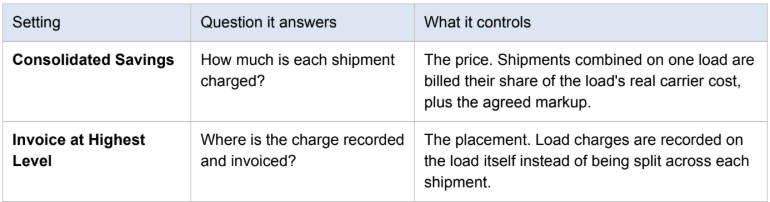
Consolidated Savings makes sure you pay your fair share of the real combined cost. Invoice at Highest Level decides whether you see that cost per shipment or on the load as a whole.
Consolidated Savings
When several of your shipments travel together on one load, the carrier typically charges less than the individual quotes would add up to.
Off: each shipment is billed the price it was quoted on its own.
On: each shipment is billed its share of the load's actual carrier cost, divided by weight, plus the agreed markup. The savings from combining shipments are passed through to you.
Example: a load costs $1,000 and carries two shipments, one at 25% of the load weight and one at 75%, with a 10% markup. The first shipment is billed $275 and the second $825.
Applies to shipments on multi-shipment loads. Shipments that are locked, or billed under a contracted billing agreement, keep their existing price.
Invoice at Highest Level
Off: a load's charges are recorded against each shipment they bill, so invoices follow shipments.
On: the load's charges are recorded on the awarded load (or trip) itself, grouped by Bill To, instead of being split across shipments.
This is a company-wide default and is not set per account.
How they work together
The settings are independent: one sets the amount, the other sets where the amount is recorded. All four combinations are valid.
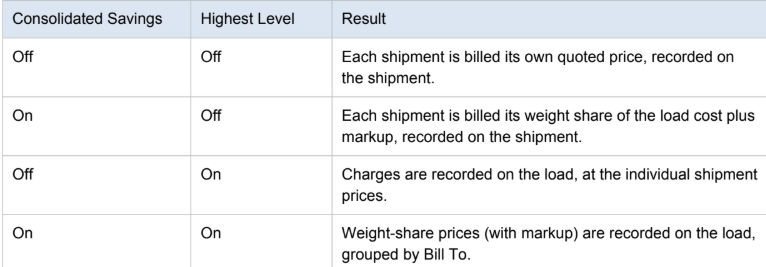
Both settings only affect charges on loads or trips. A shipment that is not part of a load is billed as usual under either setting.